
K-Pop Photocard Resale Value: Why Prices Differ So Much in Korea’s Resale Market
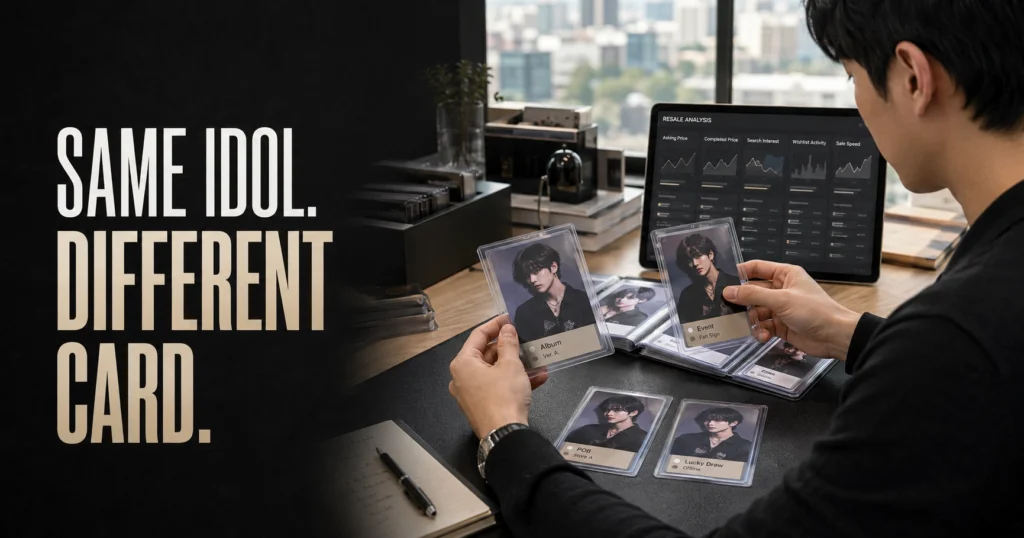
K-pop photocard resale value can differ dramatically even when two cards show the same artist—or even the same member.
The reason is that “photocard” is not one standardized product type. Album cards, pre-order benefits, Lucky Draw cards, venue benefits, store exclusives, and time-limited bonuses can enter circulation through different rules. Their secondary-market supply and buyer demand can also diverge after release.
The first question should therefore come before price: Which exact card is this?
Photocard identity comes before photocard price. Current Korean resale evidence shows that individual cards can trade at very different prices and speeds, but it does not support a fixed formula such as “POB equals expensive,” “Lucky Draw equals rare,” or “popular member equals higher price.”
Start With the Exact Card, Not the Idol Name
A member name is only one layer of identity. A useful comparison needs the artist, member, exact image or version, release, acquisition route, channel, time window, random pool, observable secondary supply, demand signal, and transaction evidence.
| Identity Layer | What to Check |
|---|---|
| Artist / Member | Who appears on the card? |
| Image / Version | Which exact photo or variant is it? |
| Release | Album, merchandise, event, or other release? |
| Acquisition Route | Album card, POB, Lucky Draw, venue benefit, store benefit? |
| Channel / Time | Which store or venue, and during what period? |
| Variant Pool | Selectable or random 1-of-N? |
| Secondary Supply | How much comparable inventory is actually available for resale? |
| Demand / Transaction | Search, interest, completed price, count, or transaction speed? |
When I first started comparing photocards, I tended to treat cards from the same artist or member as roughly comparable products. Looking at the release details changed that. The same member could have an album card, a pre-order benefit, a Lucky Draw card, and an event-only benefit with completely different acquisition routes. Since then, I have stopped using the member name as the main identifier. I confirm the exact version and where the card came from before I compare the price.
Album Cards, POBs, and Lucky Draw Cards Enter Circulation Differently
Official Weverse sales notices show how different these acquisition structures can be.
For BTS’s fifth album ARIRANG, Weverse Global’s official pre-order notice listed different benefits depending on the purchase format. A RANDOM purchase received one Weverse-exclusive unreleased selfie photocard from seven versions, while a SET received three random cards from the seven-version pool. The Early Bird period also added a separate unit photocard benefit, and Weverse stated that the Early Bird gifts could run out early because the quantity was limited.
This is why “POB” should first be read as an acquisition condition, not a price grade.
I used to see labels such as “POB,” “special benefit,” or “pre-order benefit” and mentally place them in a separate value tier. But official sales notices often show that the important details are the store, the purchase period, whether a set was required, and which benefit pool applied. That made the label itself less useful to me. I now check what the buyer actually had to do to receive that specific card.
Random Does Not Automatically Mean Rare
A “random 1 out of 7” structure tells us that the buyer cannot directly choose one specific card from the pool. It does not disclose how many copies of each card were produced or how many ultimately entered the secondary market.
Randomness describes acquisition uncertainty, not proven scarcity.
I used to read phrases like “random 1 of 6” or “random 1 of 7” and feel that the individual cards must be rare because getting the one I wanted was uncertain. But the wording does not reveal the total production quantity. It only tells me that the outcome was not selectable. Once I separated those two questions, the logic became much clearer: I do not use random allocation by itself as evidence that a card is scarce.
Lucky Draw Is an Acquisition Route, Not a Guaranteed Value Signal
Weverse’s official NCT WISH Seoul encore Lucky Draw notice shows a different acquisition structure. The event ran at a booth outside KSPO DOME from April 17 to April 19, 2026. Buyers of the specified album received one unreleased selfie photocard at random from six versions per copy, and the notice set a maximum purchase quantity of 12.
Those details establish a venue, a time window, a purchase requirement, a random pool, and a purchase limit. They do not establish how many copies of each photocard entered circulation or what buyers would later pay on the resale market.
Lucky Draw describes how the card entered circulation, not its guaranteed resale value.
Limited Access Can Matter Without Proving Resale Value
A card may be inconvenient to obtain because it requires a preorder, a particular store, a venue visit, a limited time window, or repeated random purchases. That friction can affect circulation, but it is not a direct measurement of secondary scarcity.
The broader distinction is the same one discussed in DecodingKorea’s guide to limited release conditions versus actual secondary-market scarcity: the release condition is only the starting point. What matters afterward is how much inventory owners resell, whether demand continues, and whether transactions actually complete.
Korean Resale Data Shows How High Individual Photocard Transactions Can Go
Bunjang’s official 2024 Global K-pop goods report said that the highest-value item traded on Global Bunjang from January through October 2024 was a BTS Jimin photocard that completed at KRW 3 million.
That is strong evidence that a very high individual photocard transaction can occur. It is not evidence that Jimin photocards generally trade near KRW 3 million, that member popularity caused the price, or that similar cards will appreciate.
I have seen a headline-level transaction like that and felt the pull to generalize: if one card from a member sold for an unusually high amount, perhaps the member’s cards as a whole belong in that price range. But platforms show many different cards for the same artist and member, with different releases and trading histories. I treat one high-price card as a card-level transaction, not as a member-wide valuation.
A High Price Does Not Tell You Why the Price Was High
“Popular member” is a common explanation for photocard price differences, but the current official evidence package does not isolate a member-popularity price effect while holding release, acquisition route, supply, version, and time period constant.
Buyer demand may differ between members. That is a reasonable market dimension to investigate. But it is different from claiming that member popularity by itself determines the resale price.
The same caution applies to POB status, Lucky Draw status, event access, and apparent rarity. Each may describe one part of the card’s history. None is a complete causal price model on its own.
Price, Interest, Search, and Transaction Speed Are Different Signals
Bunjang’s 2025 Global K-POP Trend Report gives a useful transaction-speed example: an ATEEZ San photocard sold 82 seconds after it was listed.
That shows very fast buyer-seller matching for that specific item. It does not show that the card had the highest price, that 82 seconds is typical for photocards, or that the card will appreciate in the future.
| Metric | What It Actually Measures |
|---|---|
| Transaction Price | How much a completed trade closed at |
| Transaction Count | How many trades completed |
| Wishlist / Interest | How many users marked or followed an item |
| Search Volume | How often a term or item was searched |
| Transaction Speed | How quickly a particular listing converted into a sale |
I used to group search activity, wishlist activity, high prices, and fast sales under one vague word: “popularity.” Looking at the metrics separately made that too imprecise. A card can be searched often without being the most expensive, and a fast sale does not automatically mean the highest value. Now I ask what the number is actually measuring before I use it as a demand signal.
This is the same measurement discipline used in DecodingKorea’s guide to transaction value, transaction count, and other recommerce metrics. Different metrics can describe different parts of market activity without being interchangeable.
Asking Price Is Not the Same as a Completed Price
KREAM’s official FAQ explains that buyers and sellers can each submit their desired prices and that a transaction is completed when the prices match. A buyer can also purchase immediately at the lowest sell bid, while a seller can sell immediately at the highest buy bid.
That mechanism illustrates a broader resale rule: listing price is seller expectation; completed price is transaction evidence.
A visible high asking price can be useful as context, but it does not prove that a buyer accepted that value.
Compare Like With Like Before Comparing Value
Photocard comparisons become more reliable when the items are genuinely comparable. Before explaining a price difference, check whether the cards match on the artist, member, exact image or version, acquisition route, event or store, and a reasonably comparable time period.
I have made this mistake when two cards looked almost identical at a glance. The artist and member matched, and even the images felt like part of the same series. But the product names revealed different album versions, store benefits, events, or Lucky Draw releases. Those small labels meant I was looking at different products. I now compare the exact same version before I try to explain a price gap.
Compare like with like before explaining value.
Identity Gaps That Make Price Evidence Unusable
The current evidence does not establish a fixed POB premium, Lucky Draw premium, member premium, or “random card” premium. It also does not prove that search volume causes price increases, that wishlist counts cause higher resale prices, or that transaction speed predicts long-term value.
Bunjang data describes activity on Bunjang and Global Bunjang. KREAM’s mechanism describes KREAM. Neither platform should be treated as a complete measurement of Korea’s entire photocard resale market.
Most importantly, a current or past transaction price is not a forecast. This article does not identify cards to buy, rank members by value, or predict future returns.
Identify the Card Before Reading the Price
When you see two very different photocard prices, work through the comparison in this order:
- Identify the exact card. Artist, member, image, version, and release.
- Identify the acquisition route. Album card, POB, Lucky Draw, venue benefit, or another route.
- Check the access condition. Store, event, purchase requirement, and time window.
- Separate randomness from supply. A random pool does not disclose production quantity.
- Check observable secondary supply. How many genuinely comparable cards are available?
- Name the demand signal correctly. Search, interest, price, count, and speed are different metrics.
- Separate asking from completed prices.
- Compare like with like. Do not compare different releases simply because the member is the same.
- Check the time period. Old and current transactions may describe different market conditions.
- Keep the platform boundary visible. One platform is not the whole Korean market.
The result is a more careful way to read photocard prices without turning collectible labels into automatic explanations.
Photocard identity comes before photocard price. A card can be random, exclusive, event-only, or difficult to obtain, but those acquisition conditions do not by themselves tell us how much the secondary market will pay for it.
Photocard Identity Worksheet
| Field | Card A | Card B |
|---|---|---|
| Artist | Same artist | Same artist |
| Member | Same member | Same member |
| Release | Album release | Concert release |
| Card type | Album inclusion | Lucky-draw benefit |
| Acquisition route | Random album pull | Purchase during a named event |
| Event / store | Not applicable | Specific participating store |
| Version | Version 1 | Event version |
| Condition | Opened; no defect disclosed | Opened; corner wear disclosed |
| Completed-price evidence | Several recent matched-card transactions | No verified matched-card transaction found |
Card A and Card B are fictional identities and the worksheet contains no real price data. Even with the same artist and member, the release, acquisition route, version, condition, and evidence base differ. Their prices should not be compared until every identity field matches or the remaining difference is deliberately being measured.
How to use the worksheet
- Complete identity fields before searching prices.
- Separate asking prices from completed trades.
- Match the condition and included packaging.
- Use a comparable time window and record the platform.
- If exact matches are scarce, report the evidence gap instead of borrowing a price from a different card.