
Why a Korean Resale Sale Price Is Not the Same as Seller Proceeds
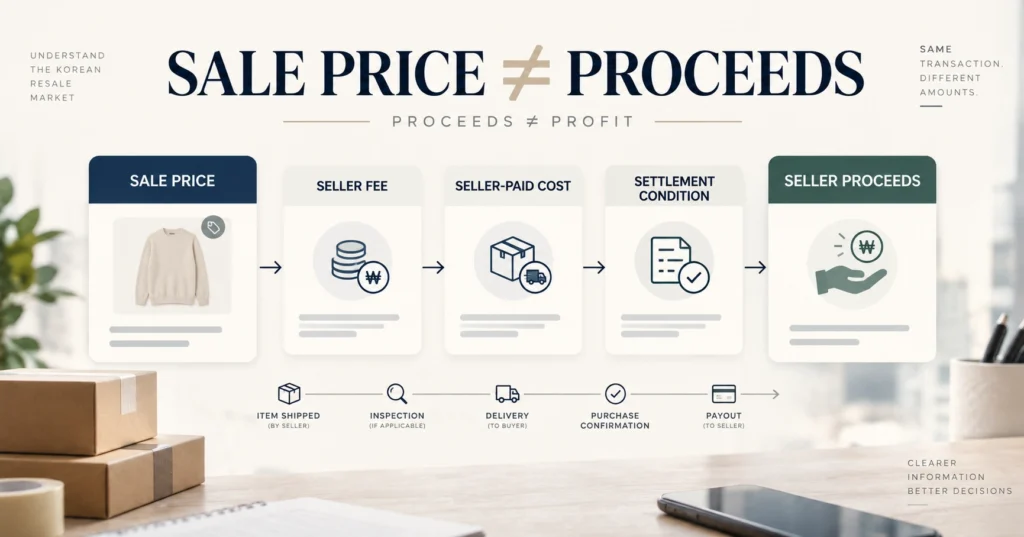
Korean resale seller fees are one reason a completed sale price may not be the same number that ultimately reaches the seller. A transaction can have a clear headline amount while the seller’s actual settlement still depends on platform fees, seller-paid costs, and the conditions that trigger payout.
That distinction sounds simple, but it changes how a resale transaction should be read. If an item sells for a certain amount, the useful next question is not only “What was the sale price?” It is also “What does the platform deduct, who pays the other transaction costs, and when does the seller become eligible to receive the money?”
I have found that it is easy to assume the agreed sale amount will simply arrive in full. Looking more closely at fee rules and settlement conditions changed that assumption for me. The visible sale price and the money that actually reaches the seller should not automatically be treated as the same number.
Gross Sale Amount and Seller Proceeds Answer Different Questions
For this article, DecodingKorea uses two practical terms.
- Gross sale amount: the headline transaction amount before applicable seller-side deductions.
- Seller proceeds: the amount that remains for settlement to the seller after applicable seller-side platform deductions and other verified seller-paid transaction costs.
This is an explanatory framework, not an accounting formula, tax formula, profit formula, or official Korean resale-industry standard.
The distinction is also different from the price-semantics problem covered in how Korean resale prices differ across platforms. That earlier question asks whether a displayed number is an asking price, bid, executable price, completed transaction price, or estimate. DK2-21 starts after the transaction amount itself is understood and asks what happens between that amount and seller payout.
A sale price describes the transaction amount. Seller proceeds describe what the seller ultimately receives under the settlement structure.
KREAM Shows Why One Percentage Is Not the Whole Story
KREAM’s current seller-fee policy gives a useful platform-specific example. Its official seller-tier and fee policy, effective March 2, 2026, says seller fees are operated across five seller levels based on transaction performance.
For ordinary-category sales, KREAM states that the service fee is made up of a ₩2,500 basic fee before VAT plus a seller-tier fee. The ordinary-category tier component currently ranges from 5.50% to 6.00% before VAT, depending on seller level. The same policy also says promotional fee rules may apply and seller-level criteria and benefits may change after advance notice.
That means the percentage alone is not the whole seller-cost structure. The same policy separately identifies shipment from the seller to KREAM’s inspection center as prepaid and seller-paid.
This is where I try not to stop at a single fee percentage. A percentage can look large or small by itself, but the actual structure may also include a fixed fee, seller-level differences, and seller-paid logistics. I find the cost structure more useful than any one fee number in isolation.
None of this proves that KREAM is more expensive or less profitable for sellers than another marketplace. It only shows that a seller’s settlement cannot be inferred from the sale amount alone.
Joonggonara Gives a Clear Deduction Example
Joonggonara’s current policy makes the deduction mechanism especially explicit.
Its official seller-fee FAQ states that, for payments completed from July 28, 2026 at 10:00 onward, the seller fee depends on the product amount:
| Product Amount | Seller Fee Under Current Cited Rule |
|---|---|
| ₩20,000 or below | 0% |
| Above ₩20,000 | 2.5% |
The FAQ says the applicable fee is deducted and the remaining amount is settled to the seller. That gives a clean example of the difference between the transaction headline number and the amount remaining for settlement.
The important boundary is that this is Joonggonara’s current cited safe-payment seller-fee rule. It is not evidence that every Korean resale transaction carries the same fee, that the fee will remain unchanged, or that the platform produces the highest or lowest seller proceeds.
Who Pays a Fee Is a Separate Question
A transaction can include a service fee without that fee necessarily being deducted from the seller.
Daangn’s September 18, 2025 announcement for its Buy Now feature provides a bounded example. At launch, Daangn said the safe-payment usage fee was charged on the buyer side and that the seller continued to bear no seller fee under that announced structure.
This does not establish a universal 2026 rule for every Daangn resale transaction. The source is useful for a narrower point: fee incidence matters. A transaction service fee may exist while the seller’s proceeds are affected differently depending on who is charged.
Settlement Timing Is Part of the Seller Economics
Seller proceeds are not only about how much remains. They are also about when the money becomes payable and what condition has to be satisfied first.
KREAM’s official settlement FAQ says that when a sold item passes inspection, the sale proceeds are deposited into the registered account on the next business day.
Joonggonara uses a different settlement trigger in its safe-payment settlement FAQ. When the buyer manually confirms the purchase, the seller’s payment is settled within one hour. If there is no manual confirmation, automatic purchase confirmation occurs after three days following delivery completion. The FAQ also notes that disputes or other settlement conditions can change the timing.
Daangn’s 2025 Buy Now announcement also described seller settlement as occurring only after the buyer received the item and confirmed the purchase.
This distinction has become important in the way I think about a sale. A transaction can feel “finished” when buyer and seller agree, but settlement may still depend on inspection, delivery, purchase confirmation, or the absence of a dispute. A sale being completed in one sense and money reaching the seller are different stages of the transaction process.
The Same Gross Sale Amount Can Lead to Different Seller Economics
Two sellers can begin with the same gross sale amount and still face different settlement economics if the platform rules differ.
| Transaction Layer | Question to Ask |
|---|---|
| Gross sale amount | What was the transaction headline amount? |
| Fee incidence | Is a service fee charged to the seller, buyer, or another side? |
| Seller-side fee formula | Is the deduction fixed, percentage-based, tiered, or combined? |
| Seller-paid transaction cost | Does the seller separately pay verified logistics or other platform-required costs? |
| Settlement condition | What must happen before payout becomes eligible? |
| Settlement timing | When is the payout actually processed? |
This framework is more useful than turning DK2-21 into a platform ranking. A lower headline fee does not automatically establish higher seller profit, and a faster payout does not automatically make a marketplace economically better.
The measurement logic is similar to the distinction between transaction value, transaction count, and active users in how to read Korean recommerce metrics: related numbers can describe the same market activity while answering different questions.
Seller Proceeds Still Do Not Tell You Profit
Seller proceeds are not seller profit.
Proceeds describe what is settled to the seller under the transaction structure. Profit would require additional information that these platform-policy pages do not establish, such as the seller’s original acquisition cost, other personal expenses, storage or logistics outside the verified platform structure, and applicable tax or business costs.
For the same reason, this article does not treat seller proceeds as taxable income and does not provide tax, VAT, or business-registration guidance.
Seller-Side Proceeds and Buyer-Side Cost Are Mirror Problems
The seller starts with a sale amount and asks what remains after applicable deductions and settlement rules. An international buyer can face the opposite problem: the displayed item price may be only the starting point before domestic handling, shipping, and cross-border logistics are added.
That buyer-side structure is covered separately in DecodingKorea’s analysis of the real cost of Korean secondhand goods.
Costs Still Missing From a Profit Calculation
The official sources used here document specific platform rules. They do not establish which Korean marketplace is best, cheapest, most profitable, or most seller-friendly. They also do not prove Korea-wide seller margins, whether sellers pass fees on to buyers, how fee levels affect market liquidity, or what future fee schedules will be.
Policies can change. KREAM explicitly says seller-level criteria and benefits may change after advance notice, Joonggonara’s current rule replaced an earlier fee structure, and Daangn’s evidence in this article is intentionally limited to its dated September 2025 Buy Now launch announcement.
Gross Price, Proceeds, and Profit Need Separate Lines
A resale sale price is only the starting number. To understand the seller side of the transaction, the reader has to identify the fee incidence, the seller-side deduction formula, any verified seller-paid costs, the condition that releases payment, and the timing of settlement.
That is why two transactions with the same headline amount can produce different seller economics without either price being “wrong.” The settlement structures are simply different.
A sale price tells you the transaction amount. The settlement structure tells you what reaches the seller.
A Seller-Proceeds Worksheet
Use a line-item calculation instead of subtracting one remembered fee percentage.
| Line | Calculation |
|---|---|
| Gross sale amount | Completed item price under the platform’s definition |
| Minus seller fee | Current fee for the seller’s tier, category, and transaction route |
| Minus seller-paid shipping | Only when the seller is responsible for it |
| Minus optional services | Authentication, promotion, withdrawal, or other disclosed charges when applicable |
| Equals estimated proceeds | Amount before the seller’s acquisition cost and other business costs |
Fictional example: a ₩100,000 gross sale minus a hypothetical 5% seller fee and ₩4,000 seller-paid shipping produces ₩91,000 in estimated proceeds. These figures are not a statement of any platform’s current fees. The live policy, seller tier, category, tax treatment, and transaction route must be checked for a real calculation.